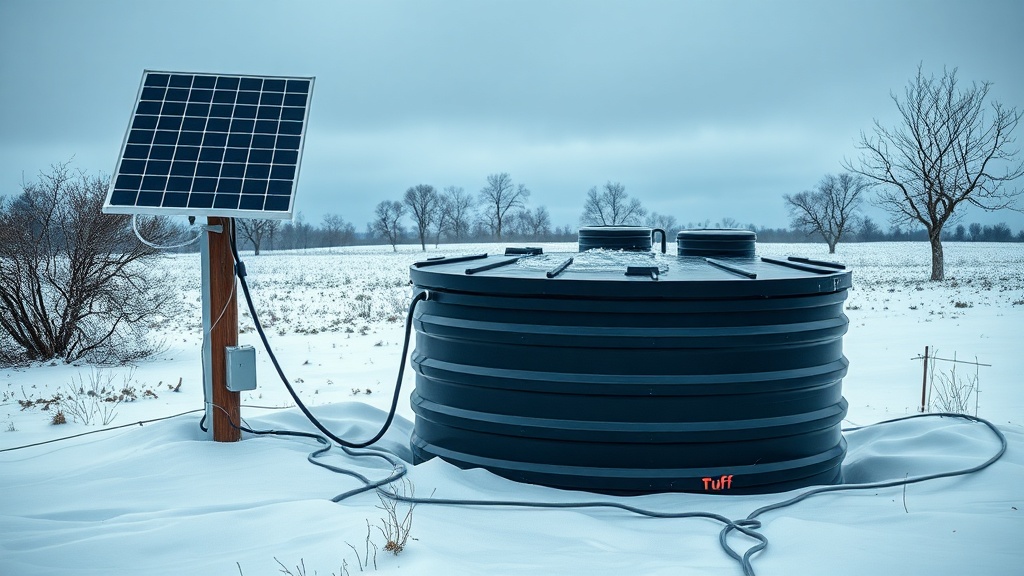
Tuff Stuff 200-Gallon Stock Tank Solar Heater Installation: Eco-Friendly Winterizing for Homesteaders
Winter presents a constant battle for livestock keepers who rely on stock tanks for hydration. When temperatures drop below freezing, a Tuff Stuff 200-gallon stock tank can develop a thick ice layer within hours, cutting off water access for cattle, horses, or sheep. Solar heater installation offers a sustainable, off-grid solution that keeps water flowing without spiking electric bills. This guide walks through the complete process of winterizing a Tuff Stuff 200-gallon tank with solar thermal or photovoltaic heating, covering equipment selection, mounting, pipe insulation, and freeze-protection strategies that hold up through brutal cold snaps.
What Are the Specific Freeze Risks for a 200-Gallon Tuff Stuff Stock Tank?
A Tuff Stuff 200-gallon stock tank presents unique freeze challenges compared to smaller models. The large surface area—typically 72 inches in diameter—exposes nearly 28 square feet of water to cold air, accelerating ice formation. The tank’s 1/4-inch-thick polyethylene walls provide decent insulation but cannot prevent freezing in sustained sub-zero conditions. Without active heating, a 200-gallon tank can develop a solid ice cap 2 to 4 inches thick overnight when temperatures drop to -10°C (14°F).
Livestock cannot break through ice thicker than about half an inch, meaning even a moderate cold spell disrupts hydration. The tank’s depth—approximately 24 inches—means bottom water stays slightly warmer than the surface, but convection currents continually circulate cooler water upward. Tuff Stuff 200-Gallon Stock Tank Size Comparison: How It Measures Up to Smaller Models shows the large water volume actually works against you in winter, as more thermal mass must be kept above freezing. Solar heating directly addresses this by adding a steady low-wattage heat source that prevents ice nucleation.
Which Solar Heating System Works Best for the Tuff Stuff 200-Gallon Tank?
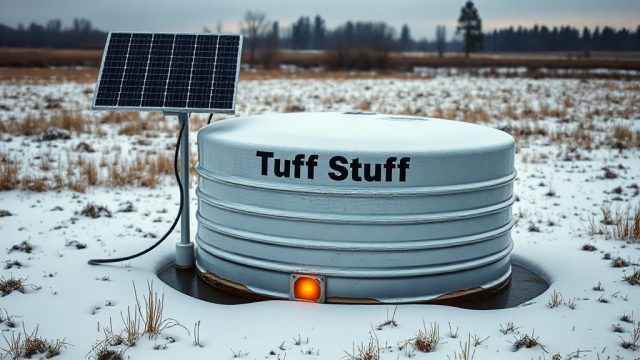
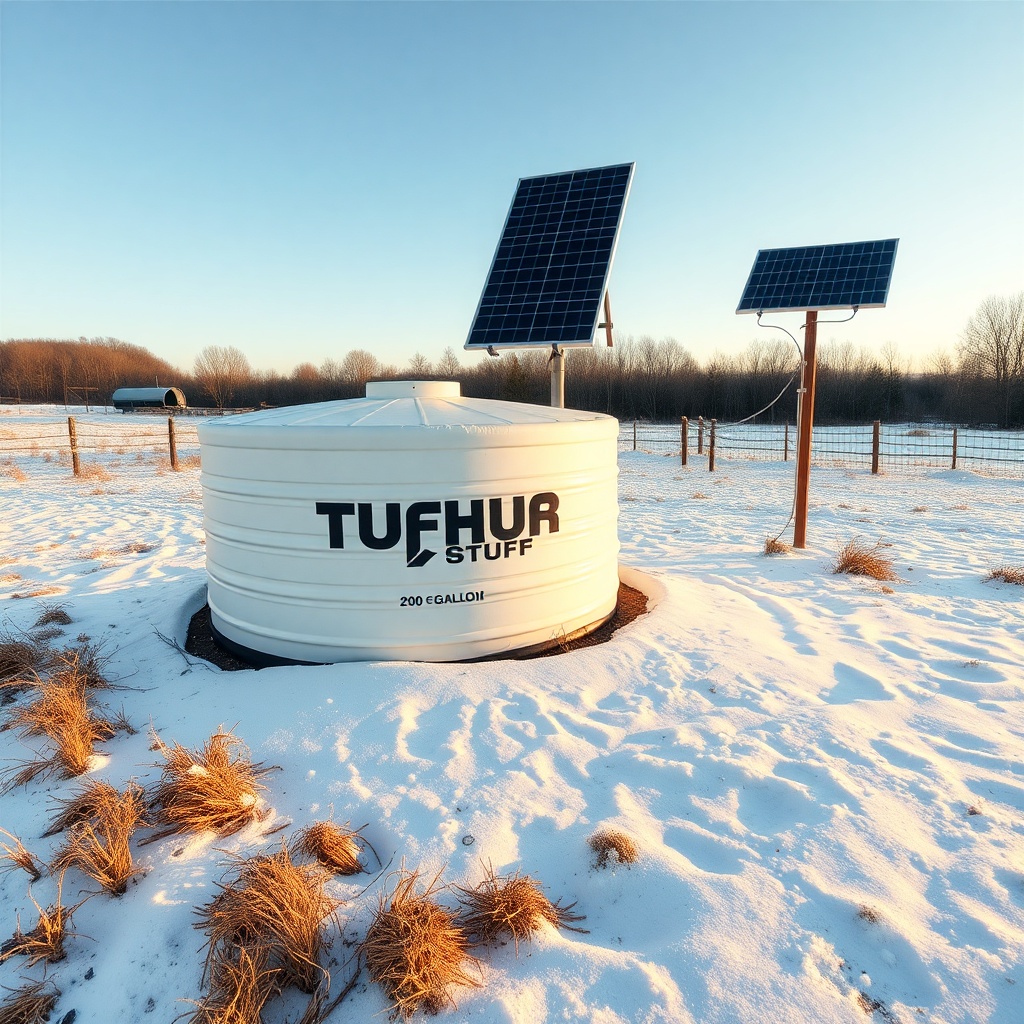
Two primary solar approaches suit the Tuff Stuff 200-gallon stock tank: photovoltaic (PV) electric heaters and solar thermal circulators. PV systems use solar panels to power a submersible or tank-mounted heater, typically 100 to 200 watts. For a 200-gallon tank in USDA Zone 5 or colder, a 150-watt heater paired with a 300-watt solar panel array offers reliable freeze protection down to -15°C (5°F). The heater must be thermostatically controlled, turning on only when water temperature falls below 4°C (39°F).
Solar thermal systems use dark absorber plates or coiled tubing that circulates tank water through solar collectors during daylight hours. These require a small DC pump (12V or 24V) powered by a dedicated solar panel. The heated water returns to the tank, raising overall temperature by 5 to 10°C (9 to 18°F) on sunny winter days. Nighttime freeze protection still requires a backup, such as a battery bank or a low-voltage heater mat. Tuff Stuff 200-Gallon Stock Tank Winterizing: Heater Installation Guide provides detailed specs for electric heater models that integrate with solar arrays.
For most homesteaders, a hybrid approach works best: a PV panel array charging a deep-cycle battery that powers a 100-watt thermostatically controlled tank heater. This setup costs £400–£700 (AU$750–AU$1,300, US$500–US$875) depending on panel wattage and battery capacity. The table below compares common solar heater configurations for the Tuff Stuff 200-gallon tank.
| System Type | Solar Panel Wattage | Heater Output | Battery Required | Estimated Cost (GBP) | Freeze Protection Down To |
|---|---|---|---|---|---|
| PV Direct (no battery) | 200W | 150W submersible | No | £380 | -5°C (23°F) |
| PV with Battery Backup | 300W | 100W thermostatic | 100Ah deep-cycle | £620 | -15°C (5°F) |
| Solar Thermal with Pump | 100W (for pump) | Heat exchanger (no electric heater) | Small 20Ah | £510 | -10°C (14°F) with backup heater |
| High-Capacity PV System | 400W | 200W heater + circulation pump | 200Ah lithium | £890 | -25°C (-13°F) |
How to Install Solar Panels and Route Cables to the Stock Tank
Begin installation by selecting a south-facing location (in the northern hemisphere) with unobstructed sun exposure from 9 a.m. to 3 p.m. during winter months. The solar panel array should mount on a sturdy post or ground rack at least 6 feet from the stock tank to prevent animals from rubbing against wiring. Tilt the panels at an angle equal to your latitude plus 15 degrees for optimal winter performance—for example, 45 degrees if you live at 30°N latitude. Use stainless steel brackets and UV-resistant cable ties to secure everything.
Run 10-gauge or 8-gauge direct-burial solar cable from the panels to a charge controller mounted in a weatherproof enclosure. Position the charge controller within 10 feet of the battery bank to minimize voltage drop. From the battery, connect a DC-powered thermostat that switches the heater on when water temperature drops below 4°C (39°F). The heater itself—typically a 100- to 200-watt submersible unit—should be placed near the tank’s center, suspended on a stainless steel bracket or inside a protective PVC housing that prevents livestock from chewing on the cord.
All cable connections must be waterproofed with heat-shrink tubing and silicone sealant. Bury cables at least 12 inches deep in flexible conduit to protect from frost heave and animal digging. Tuff Stuff 200-Gallon Stock Tank Siphon Drain Setup: Effortless Water Changes provides useful tips for routing lines near drain valves without interfering with the heating system.
What Insulation Strategies Complement Solar Heating for Maximum Protection?
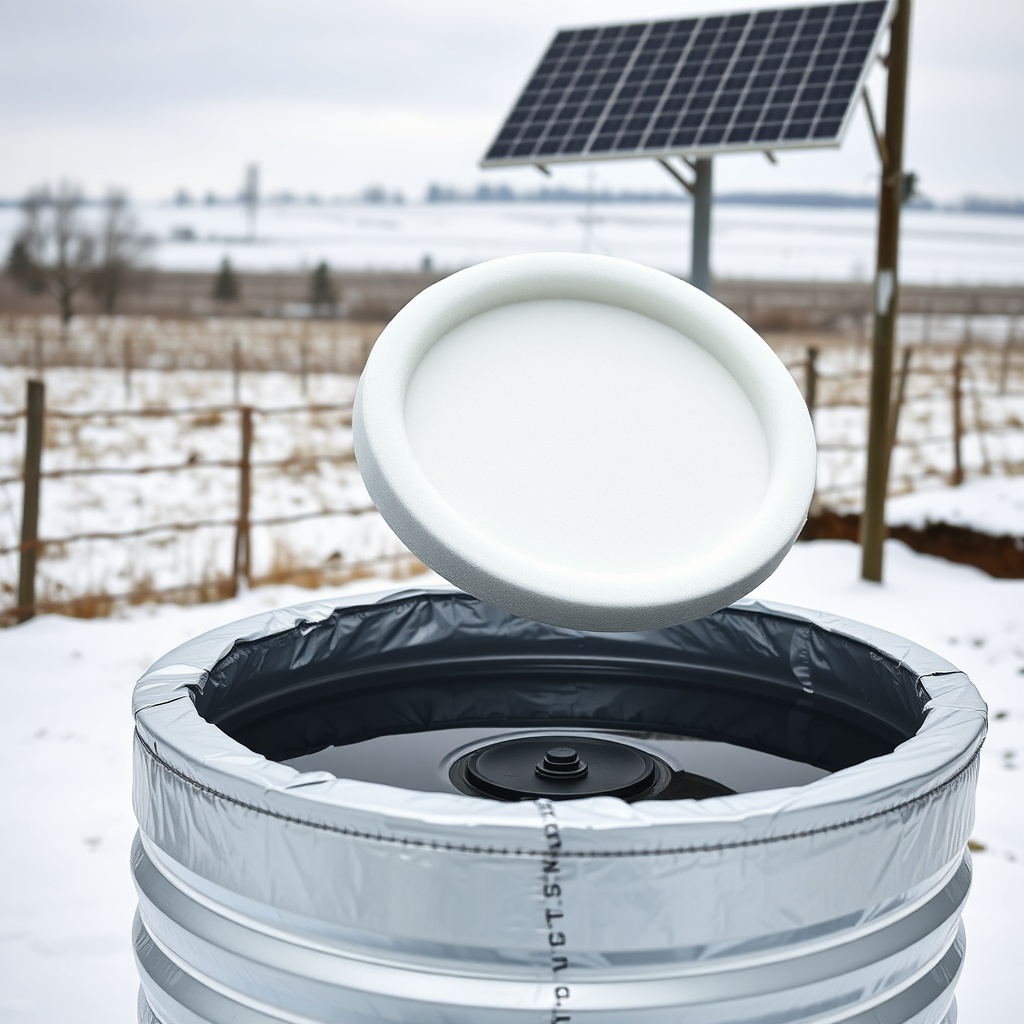
Solar heating alone may struggle during multi-day overcast periods. Pairing it with tank insulation dramatically reduces heat loss. Begin by placing the Tuff Stuff 200-gallon tank on a 2-inch-thick rigid foam insulation board (extruded polystyrene, R-value 10) cut to match the tank’s footprint. This prevents ground contact from wicking away heat. Next, wrap the exterior of the tank with a custom-fit insulating blanket made from 1.5-inch foil-faced bubble wrap or reflective foam insulation. Secure the blanket with heavy-duty zip ties or ratchet straps, ensuring no gaps at the seams.
For the water surface, consider a floating insulation cover. A 1-inch-thick closed-cell foam disk cut slightly smaller than the tank’s diameter floats directly on the water, with a cutout for the heater and a small access hole for livestock to drink. This cover can reduce evaporative heat loss by 70 percent. In extreme cold, layer a second floating cover on top. Tuff Stuff 200-Gallon Stock Tank Water Quality Testing: How to Ensure Safe Drinking Water for Livestock explains how these covers affect water quality—they require periodic cleaning to prevent bacterial buildup under the foam.
How to Maintain Freeze Protection Through Snow, Ice, and Power Outages
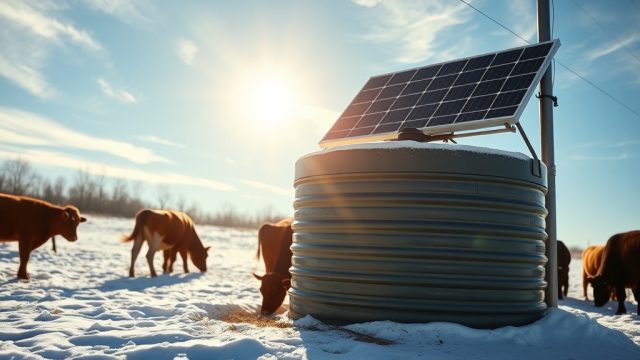
Winter maintenance is critical. Snow accumulation on solar panels can cut output by 80 percent, so install panels at a steep tilt (60 degrees for snow-shedding) or mount them vertically on a south-facing wall. Brush snow off with a soft broom after each storm. Check the charge controller display daily to confirm the battery is charging above 12.4V (for a 12V system). If voltage drops below 12.0V, the thermostat may fail to trigger the heater at night.
Inspect the tank’s water level daily during freezing weather. As livestock drink, the water level drops, and the heater’s immersion depth decreases. If the heater runs partially exposed, it may overheat or crack. Maintain a minimum water depth of 12 inches above the heater element. Also check the thermostat probe—it should be submerged and free from ice buildup. If ice forms around the probe, the thermostat may read a false temperature and keep the heater off.
For prolonged power outages (even in solar systems with battery backup), have a fallback plan. Keep a propane-powered stock tank de-icer rated at 1,000 BTU/h as emergency backup. Tuff Stuff 200-Gallon Stock Tank Buying Guide: What to Consider Before Purchase discusses additional winter accessories like floating heaters and thermometers that integrate with solar setups.
What Owners Say About Solar Heater Performance on the Tuff Stuff 200-Gallon Tank
Mark R., a cattle rancher in Alberta, Canada, runs a 300W solar system on his Tuff Stuff 200-gallon tank: “Last winter we had three weeks of -30°C with only a few sunny days. The battery backup kept the heater running every night for eight hours. We had to scrape a thin layer of ice twice, but the water never fully froze. The insulation wrap made a huge difference—without it, the heater would have run constantly.”
Emily T., a sheep farmer in the UK’s Lake District, uses a solar thermal approach with a 100W pump: “On sunny winter days, the water temperature climbs to 6°C even when air temps are -2°C. At night, it drops to 2°C, but that’s safe. I added a second floating cover, and the tank hasn’t frozen in two years. The initial cost was about £500, but we’ve saved that in electric bills.”
James L., a homesteader in Montana, warns about cable management: “The cord from the heater was chewed by a curious heifer in the first week. I built a PVC pipe sleeve for the cord, and now it’s bulletproof. Also, make sure the thermostat probe is secured—mine floated to the surface once and froze into the ice. That caused the heater to stay on all night and waste battery power.”
Frequently Asked Questions
1. How much solar panel wattage do I need for a Tuff Stuff 200-gallon stock tank?
For Zone 5 winters, a minimum of 200W of solar panels paired with a 100W thermostatic heater is recommended. For Zones 6 and colder (down to -25°C), increase to 300W–400W panels and a 150W–200W heater. The panel wattage must account for winter solar insolation—expect only 2–3 sun hours per day in December at northern latitudes.
2. Can I use a standard electric stock tank heater with solar panels?
Yes, but you need a pure sine wave inverter if the heater is AC-powered. Most solar systems use DC heaters (12V or 24V) to avoid inverter losses. A 100W DC heater is more efficient and simpler to install than an AC unit with an inverter. Check that your heater is rated for continuous outdoor submersion in freezing conditions.
3. Will the solar system keep the tank ice-free during a blizzard with no sun?
A battery bank provides 1–3 days of autonomy depending on capacity. A 100Ah deep-cycle battery at 12V stores 1,200 watt-hours, enough to run a 100W heater for 12 hours. For multi-day storms, increase battery capacity to 200Ah or have a backup generator. Insulation reduces heater run time by half, extending battery life significantly.
4. How do I prevent the heater from being damaged when the tank freezes partially?
Use a submersible heater with a built-in thermal cutoff that shuts off if the element is exposed to air. Mount the heater on a bracket that keeps it at least 6 inches above the tank bottom and 4 inches below the expected low water line. Check water level daily. If ice forms around the heater, break it gently with a rubber mallet—never a metal tool that could puncture the element.
5. Is it safe to combine solar heating with a tank cover for freeze protection?
Yes, but use a floating cover with a dedicated cutout for the heater cord and thermostat. A solid cover that traps moisture can promote algae growth and degrade water quality. Clean the cover monthly with a diluted bleach solution (1:10 ratio) and rinse thoroughly. How to Repair Cracks in Your Tuff Stuff 200-Gallon Stock Tank covers damage from expanding ice if the cover traps water.
6. What is the total cost of a full solar freeze-protection setup for a 200-gallon stock tank?
A complete system including 200W solar panels, charge controller, 100Ah battery, 100W thermostatic heater, insulation blanket, and mounting hardware ranges from £500 to £900 (AU$950–AU$1,700, US$630–US$1,130). High-end setups with lithium batteries and larger panels cost up to £1,500. The investment pays back in 2–3 winters compared to running a 1,500W electric heater on grid power.